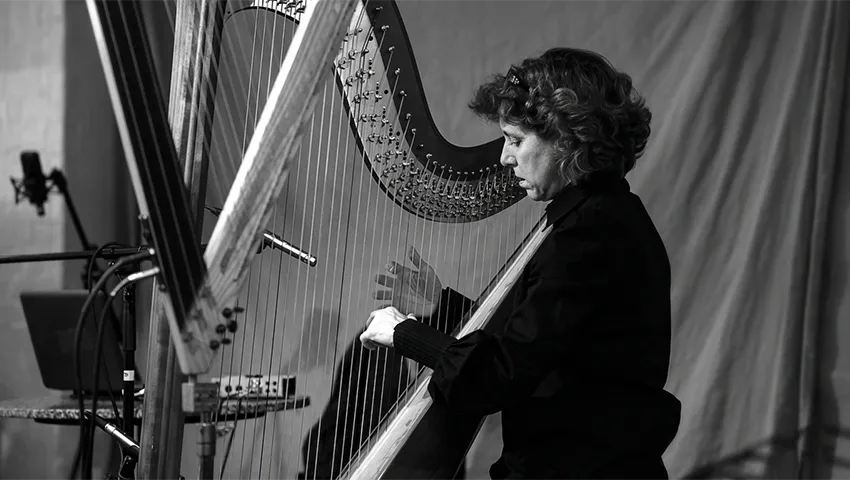
Zeena Parkins plays the harp the way you’d play an electric guitar in a noise band — and that’s meant as the highest possible compliment. One of the most original instrumentalists in experimental music, Parkins has spent four decades transforming the harp — acoustic and electric — into a vehicle for free improvisation, sound sculpture, and unapologetic noise.
A veteran of New York’s downtown scene since the early 1980s, Parkins has collaborated with John Zorn, Ikue Mori, Elliott Sharp, Björk, and countless others. She has composed for dance, theater, and film, and performed on stages from the Kitchen in New York to major festivals across Europe and Japan — always on her own terms, with her own voice.
Her place in Catalytic Sound artist-run ecosystem is entirely earned. In this Q&A, Parkins talks about the harp’s radical possibilities, the downtown scene’s lasting influence, and what it means to keep making independent music with conviction, decade after decade.
We reached out to Catalytic member Zeena Parkins in preparation of her forthcoming release, LACE on Chaikin records. LACE, released towards the end of this month, is, “a box set of scores/interviews/artifacts and an LP, a deep dive into this multi-movement composition.”
In addition to the release of LACE she also has several long term projects that will see completion in 2023. “One is based on the archives of Walter Benjamin, J’ai Plus de Souvenir Que… This is actually a project I started in 2014, so it has shifted from front to back burner many times. I just finished recording a duo piece which is the newest addition to the project with percussionist William Winant and pianist Brett Carson- Scratch in Mobile Dust. Pianist Magda Mayas, drummer Tony Buck and clarinetist Lauren Bruttin are also on the project, with recordings and performances I did with them in 2014 and 2015 in Berlin when I had the DAAD artist residency. The work, with its many components, is about how we learn, memory, language, collections and loss.”
We caught up with Zeena for a Q&A after she had just returned from Berlin, performing at the Pierre Boulez Saal in Myra Melford’s Cy Twombly Project that also includes Miya Masaoka, Michael Formanek, and Ches Smith.
Q: What artists are inspiring you lately?
A: Most inspired by the Fred Sandback show that I saw last week at the Hamburger Bahnhof, in Berlin. Work about what is not there as much as what is.
Q: Books on your nightstand?
A: Berlin Childhood around 1900 by Walter Benjamin. Obsessed with this little book: notice how Benjamin uses sound to access his primary childhood memories and experiences. This is his inoculation against forgetting.
Also the Terminal Boredom Stories by the Japanese Writer Izumi Suzuki. Ikue Mori turned me on to these! Dark, irreverent sci-fi focused on gender roles.
Q: What have you been watching?
A: Lola Montés by Max Ophuls. About a courageous woman hustler set in a surrealistic circus. The entire film dizzily whirls around in motion. As it is a film made in the 50’s, needless to say it doesn’t end well for Lola.
And these two favs, two brilliant films on filmmakers and film making: Day for Night by Truffaut and Peeping Tom by Michael Powell.
Q: Dream trio/quartet/quintet with historical figures?
A: Quartet with Daphne Oram, Max Neuhaus and Denis Charles.
Q: Last performance you saw that expanded the way you think about your own work?
A: Hearing Laetitia Sonami perform a new version of her solo, Song of Tsar, on the Spring Spyre.
Q: Record you most wish you had played on?
A: Presque Rien by Luc Ferrari
Q: Recording people would be most surprised you listen to?
A: James Tenney Three Rags
Q: What else has been inspiring you lately?
A: Not sure inspired is the correct word. I am mourning the recent loss of the Music Department at Mills College where I taught for 13 years. I had an endowed chair—the Darius Milhaud Chair of Composition- but that is over. Mills was bought by Northeastern University… and many changes are in process right now.