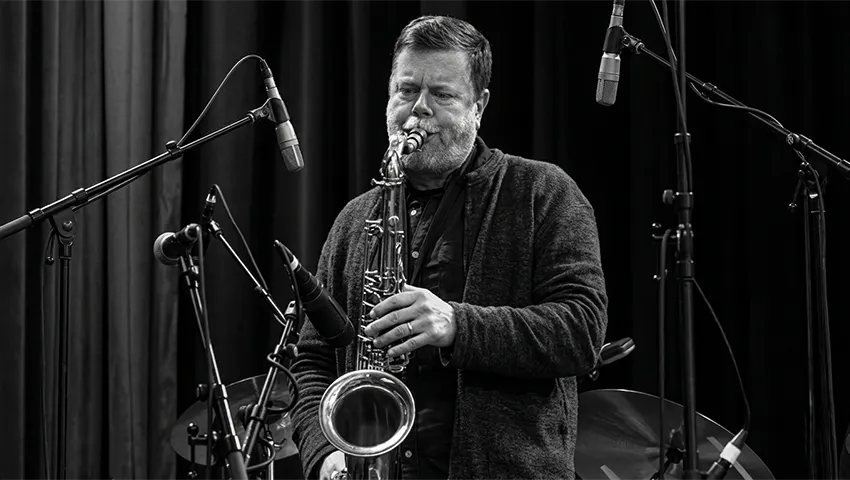
Ken Vandermark is, by any measure, one of the defining figures in contemporary creative music. A saxophonist, clarinetist, composer, and organizer whose Chicago-based practice spans more than three decades, Vandermark has built an extraordinary body of work — hundreds of recordings, transatlantic collaborations, large and small ensembles — rooted in the conviction that jazz is a living language, not a museum piece.
The recipient of a MacArthur Fellowship in 1999, Vandermark has worked with Peter Brötzmann, Mats Gustafsson, Hamid Drake, Tim Daisy, Elisabeth Harnik, Paul Lytton, and dozens of others. He runs Audiographic Records — his artist-run imprint within the Catalytic Sound cooperative — with the same rigor and intention he brings to every note.
For Vandermark, the artist-run model is not a workaround — it’s a statement. In this Q&A, he reflects on the arc of the Chicago scene, the responsibilities that come with creative freedom, and why the work of making and distributing independent music is inseparable from the music itself.
Q: What has been inspiring you lately?
A: The journalism of Mazen Kerbaj regarding the war in Gaza, and of Mykhaylo Palinchak regarding the war in Ukraine.
Q: Favorite musicians, artists, thinkers and why (current or general)?
A: Filmmakers Chris Marker & Chantal Akerman for the ongoing innovations in cinema throughout their careers; musicians Ikue Mori and Sly Stone for their constant reinvention and innovation of materials; painters Philip Guston and Kerry James Marshall for their resilience in changing the game; photographers Luigi Ghirri & Gordon Parks for permanently altering the way I think about photograph; writers Thomas Bernhard & Elfriede Jelinek for their prose and stance against right-wing politics.
Q: Favorite films, books, etc. and why (current or general)
A: Action film: “The French Connection” by William Friedkin; from its opening moment, the chase film as existentialist statement.
Biopic film: “The Passion of Joan of Arc” by Carl Th. Dreyer; if there is a perfect film, this is it.
Documentary film: “The Act of Killing” and “The Look of Silence” by Joshua Oppenheimer; two halves to the history of genocide in Indonesia during the 1960’s, each completely different in structure in content, illustrating how materials determine form.
Docu-fiction film: “Close-Up” by Abbas Kiarostami; though it’s nearly impossible for someone to invent a Prime Object (George Kubler, “The Shape of Time”), Kiarostami did so in film and, though I truly admire all of his work, “Close-Up” is my favorite.
Essay film: “Sans Soleil” by Chris Marker; I’ve watched this movie more times than any other, and each time it’s completely new, revealing itself to the way you’ve changed since the last time you saw it.
Experimental film: “Crossroads” by Bruce Conner; using stock footage of tests at Bikini Atoll run in slow motion, Conner graphically expresses the power and horror of the nuclear weapons
Narrative film: “Jeanne Dielman, 23 quai du Commerce, 1080 Bruxelles” by Chantal Akerman and “Vivre sa vie” by Jean-Luc Godard; in both cases the films revised my understanding of the shape and language of cinema.
Science fiction film: “2001: A Space Odyssey” by Stanley Kubrick; my friend, musician/designer/film-fanatic Lasse Marhaug, described it best: “2001” did not predict the future incorrectly, rather, the film is so accurately detailed it describes a parallel future that could have been.
War film: “A Man Escaped” by Robert Bresson; Bresson’s book, “Notes on the Cinematograph” and collection of interviews, “Bresson on Bresson”, transformed the way I work with music- no film better encapsulates his brilliant methodologies than this.
Western: “The Good, the Bad and the Ugly” by Sergio Leone; critics often site “Once Upon a Time in the West” as Leone’s masterpiece, but it’s his escalation of Akira Kurosawa’s story of two warring gangs from “Yojimbo” to the scale of the American Civil War and Leone’s meditation on death that has the most impact on me.
Q: Favorite record no one else has listened to?
A: No one else has ever mentioned this album to me but I’m not sure that means no one has ever listened to it! “Music of Indonesia 20: Indonesian Guitars” (Smithsonian Folkways Recordings)
Q: Best thing you’ve seen on Youtube (recently)?
Q: Dream trio/quartet/quintet with historical figures?
A: A trio with Billie Holiday and David Tudor.
Q: Last performance you saw that expanded the way you think about your own work?
A: Poet Tongo Eisen-Martin with Ben Hall (percussion) and Victor Vieira-Branco (vibraphone) at the Catalytic Sound Festival on December 6th, 2024.
Q: Record you most wish you had played on?
A: “On The Corner” (Columbia) by Miles Davis.
Q: Recording people would be most surprised you listen to?
A: I don’t have a specific album, but I’m a big fan of yé-yé girl French pop music from the 60’s, best exemplified for me by France Gall’s “Laisse tomber les filles” from 1964, composed by Serge Gainsbourg.
—
Enjoy Ken’s Artist Profile at the Soundstream!