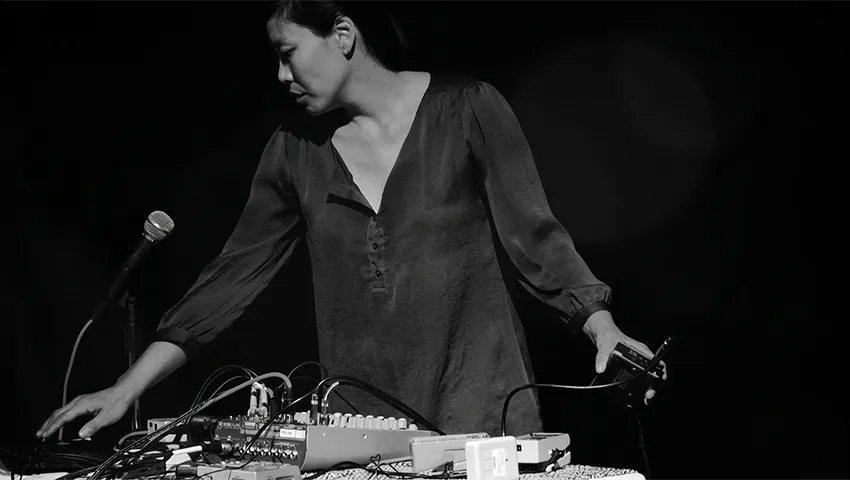
Bonnie Han Jones brings to improvised music a perspective shaped by both deep technical command and genuine curiosity about what music can mean in a community. A bassist and improviser working at the intersection of jazz, free music, and collaborative sound art, she is part of a generation of musicians expanding what the canon of creative music looks like — and who it belongs to.
Han Jones has worked within networks of improvisers that value process as much as product, dialogue as much as declaration. Her inclusion in Catalytic Sound — the artist-run cooperative that gives musicians direct access to their audience — reflects a shared belief that the best music finds its listeners through trust, not marketing.
In this Q&A, Han Jones talks about her practice, her influences, and how she navigates the work of being an independent artist in a scene that runs on passion, community, and — whenever possible — the chance to buy free jazz albums direct from the artist.
We caught up with Catalytic artist profile Bonnie Han Jones in Providence where she is currently pursuing a doctorate at Brown University. Her current project explores the archival materials of transnational Korean adoptees and is informed by feminist, queer, and postcolonial theory, and the Black radical tradition. She’s also returned to, “music performance and collaboration post-pandemic. It has been inspiring, seeing the changes in how creative communities take care of one another.” Bonnie has a number of upcoming collaborations inside different creative communities including, a forthcoming Erstwhile Records release with Asha Sheshadri.
Q: What musicians and artists have you been looking at lately?
A: Some minds I’ve been sitting with this year who have influenced (and in some cases radically changed) the way I think about history, identity, and art. Jane Jin Kaisen, Danh Võ, Karen Barad, Margo Okazawa-Rey, Natasha Barrett, Salome Voegelin, Katherine McKittrick.
Q: Films and books you’ve been into lately?
A: There’s many reasons why these have resonated with me over the past few years, one thing that connects them is their focus on sensation and ineffable truths:
“Memoria” by Apichatpong Weerasethakul
“A Thousand Times You Lose Your Treasure” by Hoa Nguyen
Q: Favorite record no one else has listened to?
A: 김대례 Kim Dae Re – 천명 (Supreme)
Q: Best thing you’ve seen on Youtube (recently)?
Q: Dream trio/quartet/quintet with historical figures?
A: Pauline Oliveros, Alice Coltrane and Buffy Sainte-Marie
Q: Last performance you saw that expanded the way you think about your own work?
A: This isn’t a performance per se, though there’s a recording of the release party at Issue Project Room. It’s an extraordinary book and audio release “The Clearing” by JJJJJerome Ellis
Q: Record you most wish you had played on?
A: A tie between Matana Roberts, Coin Coin Chapter One: Gens de Couleur Libres (2011) and
Robert Ashley’s Automatic Writing (1996)
Q: Recording people would be most surprised you listen to?
A: I have a pretty wide listening taste – maybe people would be surprised about how many Alicia Keys songs that I both know and try to sing at karaoke.